Setun: The First Ternary Computer, Shut Down Because It Was Too Cheap
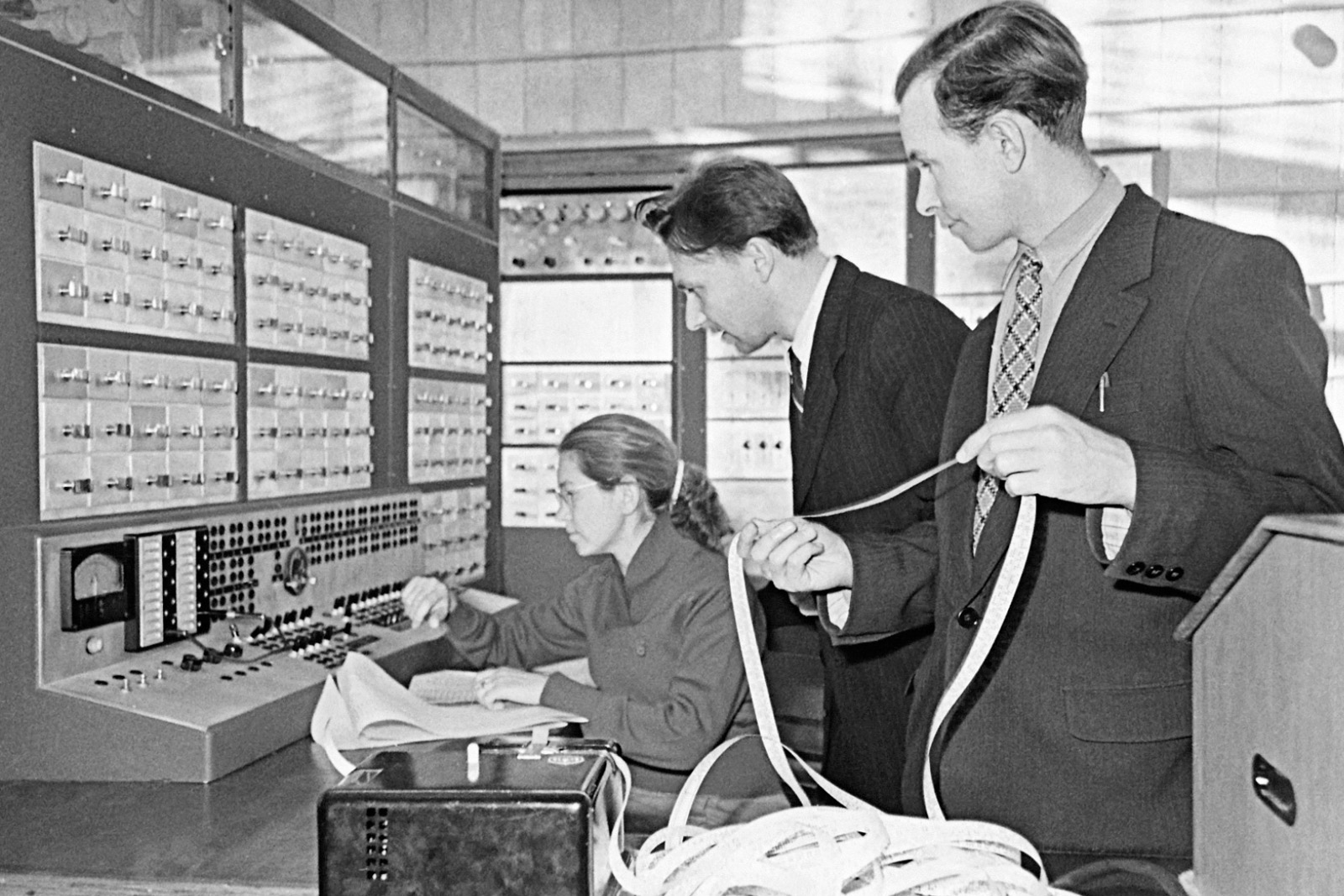
In 1958, a computer went online in Moscow that counted in ternary — not 0 and 1, but -1, 0, and +1. Setun required 7 times fewer components than comparable binary machines of the era, ran in over 30 universities, and shipped in series production of 50 units. In 1965, production stopped: the factory said the selling price was too low, and the new rector of Moscow State University called the research “pseudo-science.” This is the story of how ternary logic beat binary on efficiency — and lost for reasons that had nothing to do with engineering.
How Setun came to be
In 1953, mathematician Sergei Sobolev at Moscow State University planned to receive an M-2 computer for the university. The transfer was cancelled, so Sobolev decided to build a machine himself. In 1956, Nikolay Brusentsov — a recent graduate of the Moscow Power Engineering Institute — was appointed executive designer. Brusentsov looked at the binary computers of the time and found them “technically weak.” Instead of copying binary architecture, he chose balanced ternary logic.
The name “Setun” came from a river that flows near the university — the same naming convention as the M-1 and M-2 (“M” for “Machine”). The first model was assembled by hand in 1958 by a team that grew to 20 people.
How ternary logic worked in hardware
The basic unit of memory — a trit — was stored in a pair of magnetic cores wired in tandem. Each core could be magnetized in two directions. Two cores together provided three stable states: -1, 0, +1. This is balanced ternary — the values are centered around zero, not starting from it.
The practical advantage: negative numbers are encoded directly, with no sign bit and no two’s complement. Addition and subtraction use the same circuit path — the distinction between the two operations collapses at the hardware level. For the 1950s, this was a radical simplification of the arithmetic logic unit.
Technical specifications
| Parameter | Value |
|---|---|
| Logic system | Balanced ternary (-1, 0, +1) |
| Operating memory | 81 words x 18 trits |
| Secondary storage | Magnetic drum, 1,944 words |
| Total capacity | ~7 KB |
| Units produced | 50 (1959–1965) |
| Components vs. binary equivalents | 7 times fewer |
7 KB is 5,000 times less than a Raspberry Pi Zero’s minimum configuration. But in 1959 it was a working machine: scientific calculations, engineering problems, weather forecasting, enterprise management.
Mass production and the Kazan plant
Setun production was assigned to the Kazan Mathematical Plant by decree of the Soviet Cabinet of Ministers. The factory leadership had no interest in manufacturing computers — their primary output was different. The second factory-built model was declared unreliable, and the MSU team had to manually tune it.
Production officially began in 1961. Between 1959 and 1965, 50 units were built. Thirty of them went to Soviet higher education institutions — over 30 universities used Setun for teaching and research. The machine powered the first automated computer-based learning system at the Zhukovsky Air Force Engineering Academy.
Why it was shut down: economics, not engineering
In 1965, production halted. The reason was not technical failure but economics: the selling price was considered too low by the factory. The plant did not want to produce a computer that generated too little profit per unit. Yet Setun required 7 times fewer components than binary equivalents — meaning it was cheaper to build.
The new rector of Moscow State University dismissed Brusentsov’s research as “pseudo-science.” The lab was relocated to a dormitory attic. The original Setun prototype was destroyed. It was replaced by a binary computer that cost 2.5 times more but performed equally well.
Brian Hayes, who researched Setun’s history, noted: the machine did not fully realize the theoretical advantage of base-3 because one trit was stored in two magnetic cores — a pair of cores could have stored two binary bits. But the key reason binary systems dominated was different: industrial inertia and VLSI manufacturing criteria optimized for two-valued circuits.
Setun-70: hardware-level structured programming
Between 1961 and 1968, Brusentsov and Viktor Zhogolev developed Setun-70 — a machine with an architecture designed for structured programming. Ideas similar to Edsger W. Dijkstra’s approach were implemented at the hardware level, years before structured programming became mainstream.
Setun-70’s architecture was built around “syllables” — instructions and addresses organized in 6-trit blocks (~9.5 bits). Users could add new operations without performance loss — an extensible architecture that today reads like a precursor to microcode or RISC extensions.
The Setun-70 prototype survived the destruction of the original Setun. It later formed the basis of the “Master” educational workstation — a system for teaching programming.
DSSP: the language that outlived the machine
In the 1980s, Brusentsov with doctoral students created DSSP — the Dialogue System of Structured Programming. DSSP is a language that emulates the Setun-70 architecture on binary computers. Syntactically, DSSP is close to Forth but with a different base instruction sequence, particularly in conditional jumps.
A 32-bit version of DSSP was released in 1989. The language proved that the structured programming ideas embedded in Setun-70 were not tied to ternary hardware — they run on any architecture. DSSP is one of the early examples of a language in which control structures became first-class objects — 15 years before this became standard in mainstream languages.
Why ternary logic didn’t win
Not because it was worse. Three factors determined the outcome:
Industrial inertia. By the 1960s, the binary industry had already invested billions in manufacturing, tooling, standards, and trained engineers. Switching to ternary logic would have meant throwing away the entire infrastructure — factories, compilers, documentation, trained workforce.
VLSI criteria. Integrated circuit development followed the path of binary transistor miniaturization. Evaluation metrics (density, speed, cost) were optimized for two-valued circuits. Ternary logic was judged by binary metrics — and lost on someone else’s field.
Single-factory economics. The Kazan plant stopped producing Setun because the selling price was too low for its planning targets. A cheap, efficient computer did not fit into the pricing system — and was taken off the production line.
Setun’s legacy
Fifty shipped machines ran in 30+ universities. Setun-70 implemented structured programming ideas at the hardware level — a decade before Dijkstra popularized them. DSSP showed that ternary control structures work on binary hardware. In 2026, Ternary Computing released the 5500FP — the first commercial ternary processor on FPGA — closing the loop: from 1958 magnetic cores to today’s programmable logic.
The Setun river still flows near Moscow State University. The computer named after it proved that ternary logic is not a mathematical abstraction — it is a working engineering system. It was not shut down because it did not work. It was shut down because it worked too well for too small a price — and the pricing system proved stronger than engineering efficiency.
What’s next
The next article is a practical checklist: how to explore ternary logic on the 5500FP. A weekend step-by-step plan: install the tools, write your first assembly code, run it on the emulator, measure information density. If Setun is history, the 5500FP is something you can touch right now.