Qwen 3.7 Max Costs 51% More Outside China: Alibaba’s Geographic Pricing Strategy
Alibaba’s latest flagship model Qwen 3.7 Max, released on May 21, 2026, is positioned as a purpose-built AI for the agentic era. The model supports both standard and reasoning (thinking) modes, and ranks in the top 15 across coding, math, and reasoning benchmarks on LM Arena. But the pricing structure on Alibaba Cloud’s Model Studio reveals a sharp geographic divide: the same API costs 51% more for international users than for Chinese mainland customers.
The Numbers: $1.65 vs $2.50 Per Million Input Tokens
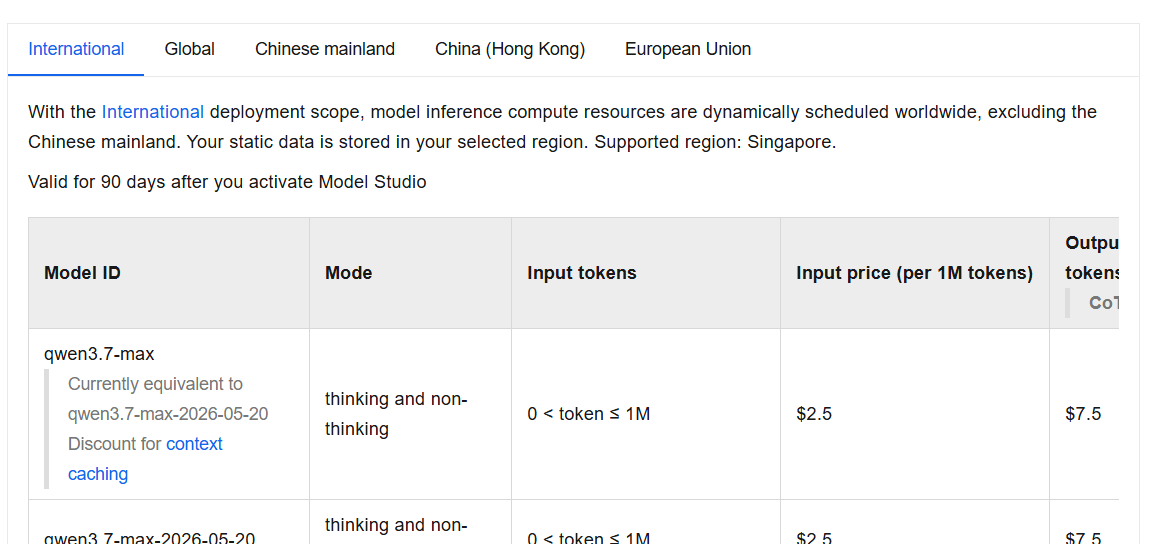
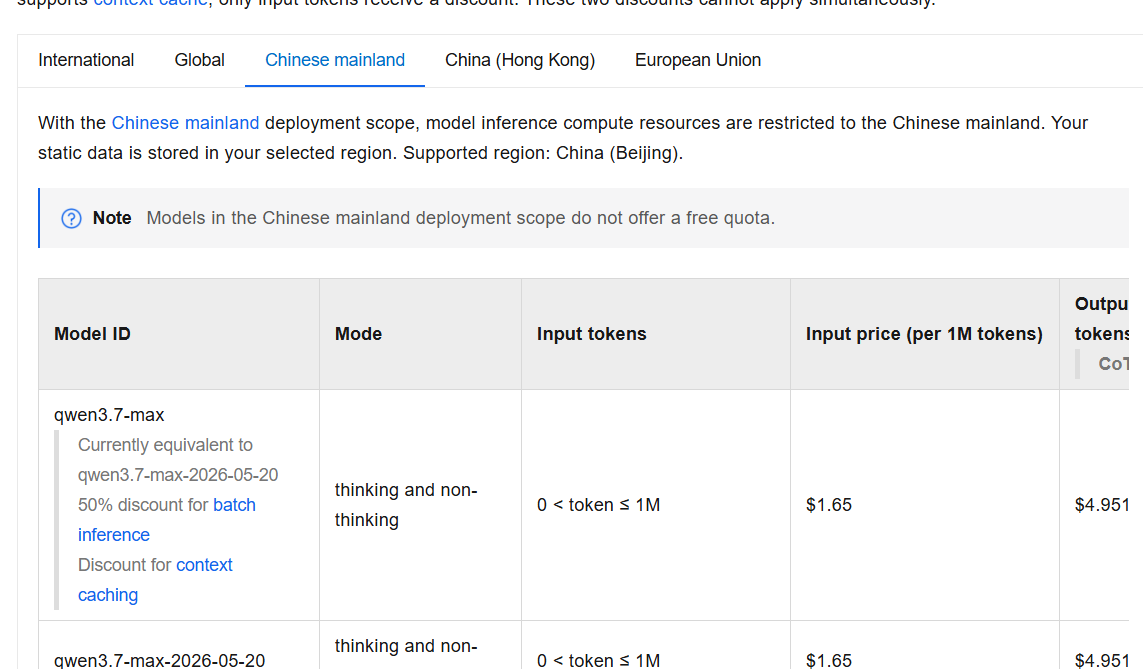
The pricing discrepancy is straightforward and consistent across both input and output tokens. For Chinese mainland deployments (Beijing region), input costs $1.65 per million tokens and output costs $4.95. International deployments (Singapore region) charge $2.50 for input and $7.50 for output — a uniform 51% markup across the board.
| Deployment Zone | Input (per 1M tokens) | Output (per 1M tokens) | Region |
|---|---|---|---|
| Chinese Mainland | $1.65 | $4.95 | Beijing |
| International | $2.50 | $7.50 | Singapore |
| Markup | +51% for international users | ||
Both tiers support thinking and non-thinking inference modes. The Chinese mainland deployment offers no free tier quotas but provides a 50% discount on batch inference and context caching discounts. The international tier includes context caching but no batch discount. International pricing is valid for 90 days after Model Studio activation, after which standard rates may apply.
Where Qwen 3.7 Max Stands in the Benchmark Race
On the LM Arena leaderboard (as of late May 2026), Qwen 3.7 Max holds competitive positions across key categories. In WebDev tasks, the model scores an ELO of 1541, ranking 4th overall. For coding, it places 9th; for math, 8th; and for reasoning on hard prompts, 15th. The overall Text Arena rank is 14th.
The model sits just behind the dominant Claude Opus 4 series (which holds ranks 1–4 in coding and 1–6 in math) and competitive Gemini 3 models. GPT-4o, by contrast, has fallen significantly — ranking 46th in math and 103rd in coding on the same leaderboard. Qwen 3.7 Max effectively occupies the tier between the top Western frontier models and the rapidly improving open-source alternatives.
How It Compares to Other Qwen Models
Within Alibaba’s own lineup, Qwen 3.7 Max is the most expensive text model, priced above the previous flagship Qwen3-Max. The older Qwen3-Max (international deployment, 0–32K tier) charges $1.20 for input and $6.00 for output — roughly half the input cost of the newer 3.7 variant. The mid-tier Qwen3.5-Plus comes in at $0.40 input and $2.40 output, making it 6 times cheaper on input tokens while offering a 1 million token context window versus 3.7 Max’s smaller window.
| Model | Input (per 1M) | Output (per 1M) | Context Window |
|---|---|---|---|
| Qwen 3.7 Max (Intl) | $2.50 | $7.50 | Not published |
| Qwen3-Max (Intl) | $1.20 | $6.00 | 262K |
| Qwen-Max | $1.60 | $6.40 | Not published |
| Qwen3.5-Plus | $0.40 | $2.40 | 1M |
| Qwen3.5-Flash | $0.10 | $0.40 | 1M |
Qwen 3.7 Max commands a premium over every other Qwen model, reflecting its positioning as the agent-focused flagship rather than a general-purpose workhorse.
The Geographic Pricing Pattern Across AI Providers
Alibaba’s geographic pricing is not unique in the AI API market, but the magnitude of the markup stands out. Most cloud providers apply regional adjustments to reflect local infrastructure costs, regulatory compliance, and tax regimes. Amazon Bedrock, Google Cloud Vertex AI, and Azure OpenAI all have region-specific pricing, though the differentials typically range from 5% to 20% between US and Asia-Pacific zones.
The 51% gap for Qwen 3.7 Max is significantly wider. One factor is that Chinese mainland data center costs — power, cooling, hardware procurement — are structurally lower than in Singapore or other international hubs. Another is that Alibaba’s domestic market operates under different competitive pressures and customer expectations. For international developers, the effective cost of using Qwen 3.7 Max is closer to mid-tier Western pricing, reducing the traditional “Chinese AI is cheaper” advantage.
Practical Implications for Developers
For developers outside China, the $2.50 input rate places Qwen 3.7 Max in a specific cost bracket. Claude Opus 4.6 charges $15 per million input tokens — making Qwen 3.7 Max approximately 6 times cheaper on input while delivering competitive benchmark scores. GPT-4o, at $2.50 input and $10 output, is priced identically on input but more expensive on output.
The cost calculation depends heavily on the use case. For agent workloads where the model generates large volumes of output (tool calls, multi-step reasoning chains), the $7.50 output cost is the dominant expense. A typical agentic session consuming 10K input tokens and producing 50K output tokens would cost approximately $0.40 on Qwen 3.7 Max international versus $0.26 on Chinese mainland — a $0.14 per-session difference that compounds at scale.
Is the International Premium Worth Paying?
The decision depends on data residency requirements and latency needs. Singapore deployment provides lower latency for users in Southeast Asia, Oceania, and the Middle East, while Chinese mainland deployment may face connectivity challenges from outside China due to the Great Firewall. For latency-sensitive applications, the 51% premium may be justified purely by network performance.
For cost-sensitive workloads where latency is less critical, the batch inference discount available on the Chinese mainland tier (50% off) effectively halves the output cost to $2.475 per million tokens — making it competitive with Qwen3-Max’s standard international pricing. Developers running non-real-time agentic pipelines should evaluate whether batch mode on the mainland tier delivers better economics despite the operational complexity.
Conclusion
Qwen 3.7 Max is a capable model that competes with the best in coding and math benchmarks while costing substantially less than Claude Opus 4 on a per-token basis. The 51% geographic price differential is a strategic choice by Alibaba — cheaper for domestic users who form the core market, premium-priced for international users where alternatives like Claude and GPT set a higher price anchor.
For developers building agentic systems, the model offers strong value at either price point. The international rate of $2.50/$7.50 undercuts Western frontier models by a factor of 2 to 6, while the Chinese mainland rate of $1.65/$4.95 remains one of the cheapest ways to access top-tier reasoning capabilities through an API.