Why Dogs Come in So Many Shapes and Sizes, While Cats Mostly Don’t

Dog breeds can differ in body weight by dozens of times, alongside enormous differences in legs, heads, and proportions. Cats vary too, but their range is much narrower: organised pedigree breeding expanded only about 150 years ago, while distinct dog types existed thousands of years earlier. The history of hunting dogs, heavy guardians, and tiny companions helps explain that gap, and raises an interesting question about what another thousand years of cat breeding could produce.
The size gap is much bigger than a difference in fur
A Chihuahua and a Mastiff show what the dog comparison involves. For cats, a Singapura and a large Maine Coon provide a useful comparison. These are adult breed references, with sex and context specified; they are not absolute limits for either species.
| Breed | Body weight | What the figure means |
|---|---|---|
| Chihuahua | 1–3 kg (2.2–6.6 lb) | The FCI standard specifies this range, with an ideal of 1.5–2.5 kg. |
| English Mastiff | 73–104 kg (160–230 lb) | Adult males, according to the Old English Mastiff Club. |
| Singapura | About 2.7–3.2 kg (6–7 lb) | Adult males in the CFA breed description. |
| Maine Coon | Large males can reach about 8–9 kg (18–20 lb) | A size reference from the GCCF, rather than a breed average or a maximum. |
A 2 kg dog and an 80 kg dog differ fortyfold in weight. A 3 kg cat and a 9 kg cat differ threefold. Both pairs differ visibly, but the dogs differ far more in overall scale. This is why even very different cats can still look like variations on a familiar body plan.
Different jobs encouraged different bodies
Running down prey, entering a burrow, guarding property, and pulling loads place different demands on a dog. A long-legged runner, a compact underground hunter, and a heavy guardian benefit from different proportions. Choosing which animals reproduce can preserve those differences across generations. Small companions added another reason to select for size: people wanted dogs that fitted comfortably into domestic and court life.
This deliberate assessment has a long history in China too. The Henan Museum traces official duties involving the evaluation of dogs to the Western Zhou period, roughly 3,000 years ago. The Chengdu Museum describes companionship and pleasure becoming increasingly important reasons to keep dogs during the Han period. Neither account establishes the birth date of a modern breed, but both show that people were making choices about dogs long before kennel clubs existed.
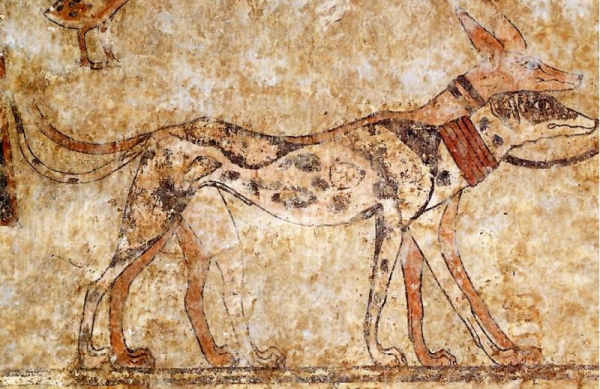
Distinct dog types are thousands of years older than kennel clubs
A 2025 study of 643 canid skulls, published in Science, found substantial variation among early Holocene dogs. In that sample, recognisable dog skull morphology was present around 11,000 years ago. Later images and texts make particular types easier to distinguish. The dates below mark documented evidence or organised breeding milestones; ancient dogs cannot simply be assigned today’s breed names.
| Period | Type or breed | What the evidence supports |
|---|---|---|
| Third millennium BCE | Egyptian dogs resembling sighthounds | UCL’s account of ancient Egyptian dogs describes a common type with a long muzzle, neck, and limbs during the Old Kingdom, about 2686–2181 BCE. |
| Around 1000 BCE | Small, stocky dogs in China | The AKC’s historical account mentions short, stocky Chinese dogs at this date as likely distant ancestors of the Shih Tzu. That ancestry is an interpretation, rather than a securely dated origin for the modern breed. |
| Seventh century BCE | Powerful Assyrian hunting dogs | A relief from Ashurbanipal’s lion hunt depicts a massive dog, discussed by the University of Chicago. It supports an ancient heavy hunting type. |
| First century BCE to first century CE | Farm guards and flock protectors | Varro and Columella describe different requirements for working dogs, including a heavy body, large head, and broad chest for a farm guardian. |
| Eighth century CE | Pekingese-type palace companions | The Kennel Club traces short-legged, short-faced dogs of this type to Tang China, more than 1,200 years ago. |
| Middle Ages | Short-legged hunters behind the Dachshund | The FCI history describes breeding dogs suited to underground hunting. The German breed club followed much later, in 1888. |
| 1899 | German Shepherd Dog | The FCI standard dates methodical breeding to 1899, using existing German herding dogs. |
A recent pedigree does not mean a recent body type
Most modern dog breeds are relatively young. A 2014 review of dog genetics described most as less than 200 years old. That makes sense once a working population is distinguished from a breed governed by a written standard and recorded ancestry. A nineteenth-century club could formalise dogs whose ancestors had already been selected for particular jobs for centuries.
People also continued changing those dogs after registration. Modern standards, controlled mating, and preferences for particular appearances intensified selection. Today’s variety combines ancient differences with much more recent breeding, rather than representing a set of breeds preserved unchanged since antiquity.
Cats already had a body suited to their main job
For cats, the main practical demand was catching small rodents. A compact, agile predator already did that well, giving people fewer reasons to reshape it into several very different working forms. Researchers discussing the development of cat breeds identify this weaker pressure to alter cats’ original form and function. There was no comparable demand for a cat that pulled loads or guarded livestock.
Many cats also reproduced outside tightly managed breeding lines. Their long association with people should therefore be distinguished from deliberate selection for a particular appearance. Domestication, choosing useful breeding animals, and maintaining a modern pedigree are related processes, but they do not share a single starting date.
The organised cat-breeding boom is only about 150 years old
A useful milestone is Harrison Weir’s 1871 Crystal Palace cat show. Shows encouraged people to compare appearances, define desirable features, and organise breeding around them. A 2022 genetic study of more than 11,000 cats describes pedigree populations emerging over approximately the preceding 150 years.
Regional types and distinctive coats existed earlier. What expanded was the organised effort to preserve and develop many separate breeds. So the useful comparison is roughly a century and a half of modern cat breeding against a much longer history of selecting dogs in different directions. It does not mean nobody bred cats before 1871.
Breeding can change cats, but genetics affects the result
Existing cats already demonstrate that their appearance can change substantially. The UC Davis Veterinary Genetics Laboratory describes variants of the same gene, KRT71, associated with the Sphynx’s nearly hairless coat and the Devon Rex’s curly coat. Cat breeding has produced obvious differences, even within its relatively short organised history.
For dogs, NHGRI’s research identifies IGF1 and other genes involved in body size. Selection can increase the frequency of existing variants and combine them in new ways. Cats have their own inherited variation and relationships between traits, so equal numbers of generations would not guarantee equal results. Selection for an unusual appearance can also preserve harmful traits, making health part of the limit on what breeding should pursue.
A thousand years of cat breeding is an interesting thought experiment
My suspicion is that cats would look considerably more varied if people had spent a thousand years selecting them consistently for different sizes and proportions. Their existing breeds show that there is variation to work with. But this is a hypothesis, not a measured forecast: the history of dogs does not establish that breeding could produce a healthy domestic cat the size of a Mastiff.
A large part of the explanation lies in what people wanted from each animal. Dogs were selected as runners, burrow hunters, guardians, and small companions long before modern breed registers. Cats spent much of their history doing a job their existing bodies already handled well, followed by a relatively recent expansion in pedigree breeding. More time and different goals could have produced a wider range of cats; exactly how wide remains an open question.